http://www.dailymail.co.uk/sciencetech/article-3151637/Are-electric-cars-damaging-region-Maps-reveal-EVs-WORSE-environment-gas-guzzling-vehicles.html
별 관심이 없던 뉴스였는데 요즘 전기자동차가 대안인 양 언론이 바람 넣고 있네요....
작년인가 취중에 대충 번역했었는데 그러면 안 될 것 같아 다시 번역했습니다.
They have been hailed as the environmentally-friendly solution to getting around towns and cities.
But new research has found electric cars have an overall impact on pollution that may be worse than gas-guzzling vehicles.
The study looked at US vehicle emissions on a county-level to map where gas cars and electric vehicles cause the most damage to the environment.
It found that in the east of the US, the impact of charging up EVs overnight does more harm to the environment than going to the petrol station.
전기자동차는 환경 친화적인 것으로 각광 받아 왔다.
하지만 최근 연구에서 전기자동차는 기름을 많이 소비하는 자동차보다 환경에 더 많은 해를 줄 수도 있음을 발견했다.
이 연구는 미국에서의 휘발유차와 전기차가 환경에 미치는 영향을 측정하여 지도로 나타내었다.
그 결과 전기차는 휘발유차보다 동부의 환경에 더 많은 해를 끼쳤다.
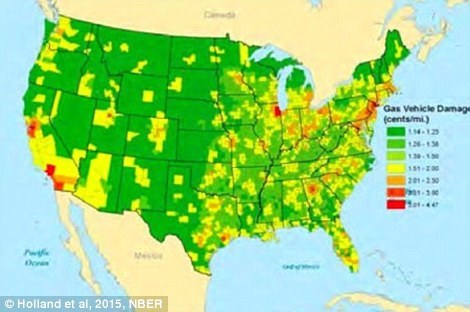
휘발유차가 환경에 미치는 영향
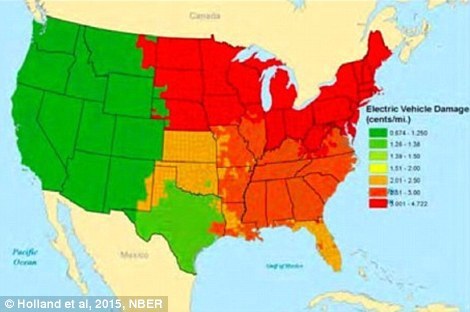
전기차가 환경에 미치는 영향.....빨간색으로 갈수록 나빠짐...
'What we find is that the benefits are substantially different depending on where you are in the country,' study co-author Stephen Holland of the University of North Carolina, told CityLab.
The real big take-home message is: location, location, location.'
The study, by the National Bureau of Economic Research, looked at five major pollutants: carbon (CO2), sulphur dioxide (SO2), nitrogen (NOx), particulate matter (PM 2.5), and volatile organic compounds (VOCs).
They took into account 11 different 2014 models of EVs, as well as the 'closest substitute' gas car.
For gas cars, the researchers studying the car's fuel-efficiency rating, the average wind patterns in an area and other environmental factors, such as farmland.
이 연구는 5가지 공해물질에 주안점을 두었다. - 이산화탄소, 이산화황, 질소산화물, 초미세먼지, 휘발성 유기화합물.
원구원들은 2014년식 11개의 서로 다른 전기차와 이와 가장 가까운(대조군으로)11대의 휘발유차의 평가를 조사했다.
가스 차에 대해선 연비효율, 한 지역에서의 평균 바람 패턴과 농장과 같은 다른 환경적 요소도 조사했다.
This provided researchers with the total emissions of driving a certain gas car one mile in a given U.S. county.
For EVs, researchers analysed at how much electricity each car drew from a regional grid and the hourly emissions profiles for the five pollutants at 1,486 power plants across the U.S.
This gave them a figure for the amount of environmental damage that car produced at the power plant, according to a report in CityLab.
Overall the results showed that the west of the US is a lot cleaner than the east when it comes to driving EVs.
이것으로 연구원은 미국에서 휘발유차 한 대가 1마일을 움직일 때의 전체 방출량을 계산할 수 있었다.
전기차에 대해서는 각 차가 얼마나 많은 전기를 지역 고압선을 통해 끌어오는지와
미국전역의 1,486개의 발전소에서의 5가지 오염물질의 시간 당 방출량을 측정하였다.
이것으로 그들은 발전소에서 전기차가 생산한 환경오염물질의 총량을 계산할 수 있었다.
전반적인 결과는 전기차만 놓고 본다면 서부가 동부보다 훨씬 깨끗했다.
(휴발유차는 연비와 환경 요소 고려...
전기차는 주유소(전기소)에서 끌어쓴 전기량을 계산해 이 전기를 만든 발전소에서 저 전기를 만들기 위해 시간 당 얼마의 오염물질을 배출했나를 조사했다는 얘기...)
In monetary terms, electric cars are about half-a-cent worse per mile for the environment than gas-powered cars.
With gas cars, the worst damage, which is shown on the map in red, took place in highly-populated urban areas such as New York.
Environmental damage for EVs appears to be worse in the Midwest and Northeast, where the electricity grid tends to rely on coal power plants.
화폐로 표현하자면 전기차는 휘발유차보다 환경에 대해 1마일 당 0.5센트 더 나빴다.
휘발유차의 가장 나쁜 데미지는 지도에서 빨간색으로 표시되어 있듯이
뉴욕과 같은 인구밀도 높은 지역에서 나타났다.
전기차의 환경에 대한 데미지는 중서부와 동북가 높았는데 이곳은 석탄연료를 사용하는 발전소가 많은 곳이다.
In places like LA, EVs produce less environmental damage because the city's air shed traps pollutants from gas cars.
Here, electric cars are 3.3 cents per mile better for the environment than gas-powered vehicles. Outside of populated areas, electric cars are generally 1.5 cents per mile worse than gas-powered.
The federal government currently pays $7,500 for every electric car purchased ? a subsidy that the study authors say the US should scrap.
LA와 같은 지역에서 전기차는 환경에 덜 데미지를 주었는데 이것은 LA가 휘발유차로부터 나오는 오염물질이 대기에 갖혀 있기 때문이다.(적어도 LA는 석탄화력발전소는 아님)
여기(LA)에서 전기차는 휘발유차보다 환경에 대해 1마일당 3.3센트 더 좋았다.
연방정부는 전기차 구입에 8백5십만원의 보조금을 지불하고 있다.
'Because electric vehicles, on average, generate greater environmental externalities than gasoline vehicles, the current federal policy has greater deadweight loss than the no-subsidy policy,' the authors write.
'It's kind of hard to beat gasoline' for public and environmental health, said co-author Julian Marshall, an engineering professor at the University of Minnesota.
'A lot of the technologies that we think of as being clean ... are not better than gasoline.'
The key is where the source of the electricity all-electric cars.
If it comes from coal, electric cars produce 3.6 times more soot and smog deaths than gas, because of the pollution made in generating the electricity, according to a separate study published in December by the Carnegie Institution for Science.
The states with the highest percentage of electricity coming from coal, according to the Department of Energy, are West Virginia, Wyoming, Ohio, North Dakota, and Illinois.
But if the power supply comes from natural gas, the all-electric car produces half as many air pollution health problems as gas-powered cars do.
And if the power comes from wind, water or wave energy, it produces about one-quarter of the air pollution deaths.
“전기차는 전반적으로 휘발유차보다 환경외부효과가 크기 때문에 현재와 같은 정책을 유지한다면 보조금을 주지 않았을 때보다 더 큰 사중손실이 따른다.
공중과 환경 건강을 위해 휘발유를 이기기는 어렵다.“
“우리가 깨끗하다고 여기는 많은 기술이 휘발유보다 낫지 않다.
만일 전기를 석탄으로 생산한다면 전기차는 휘발유차보다 3.6배나 많은 숯검댕과 죽음의 스모그를 배출한다. “고 공동 연구원 중 한 명이 말했다.
석탄으로 가장 많은 전기를 쓰는 주는 웨스트버지니아, 와이오밍, 오하이, 노스다코다, 일리노이주였다.
하지만 만일 전기를 천연가스로 생산한다면 전기차는 휘발유차가 만드는 공해문제를 절반으로 줄일 수 있을 것이다.
그리고 만일 바람, 물 혹은 파도 에너지로 생산한다면 죽음에 이르는 대기오염 문제를 4분의 1로 줄일 수 있을 것이다.
아래는 우리나라 석탄화력발전소에서 나오는 미세문제의 심각성을 다룬 기사.
http://media.daum.net/economic/others/newsview?newsid=20151119055407687










 제목
제목


 이전글 :
이전글 :  다음글 :
다음글 : 


